
Case Study
How RuteAppz Built a Custom Manufacturing ERP for TexPump, a Pump and Motor Manufacturer
An integrated ERP for a Coimbatore pump and motor manufacturer, covering raw-material inventory, production tracking, material reconciliation, supplier records and output-based employee wages.
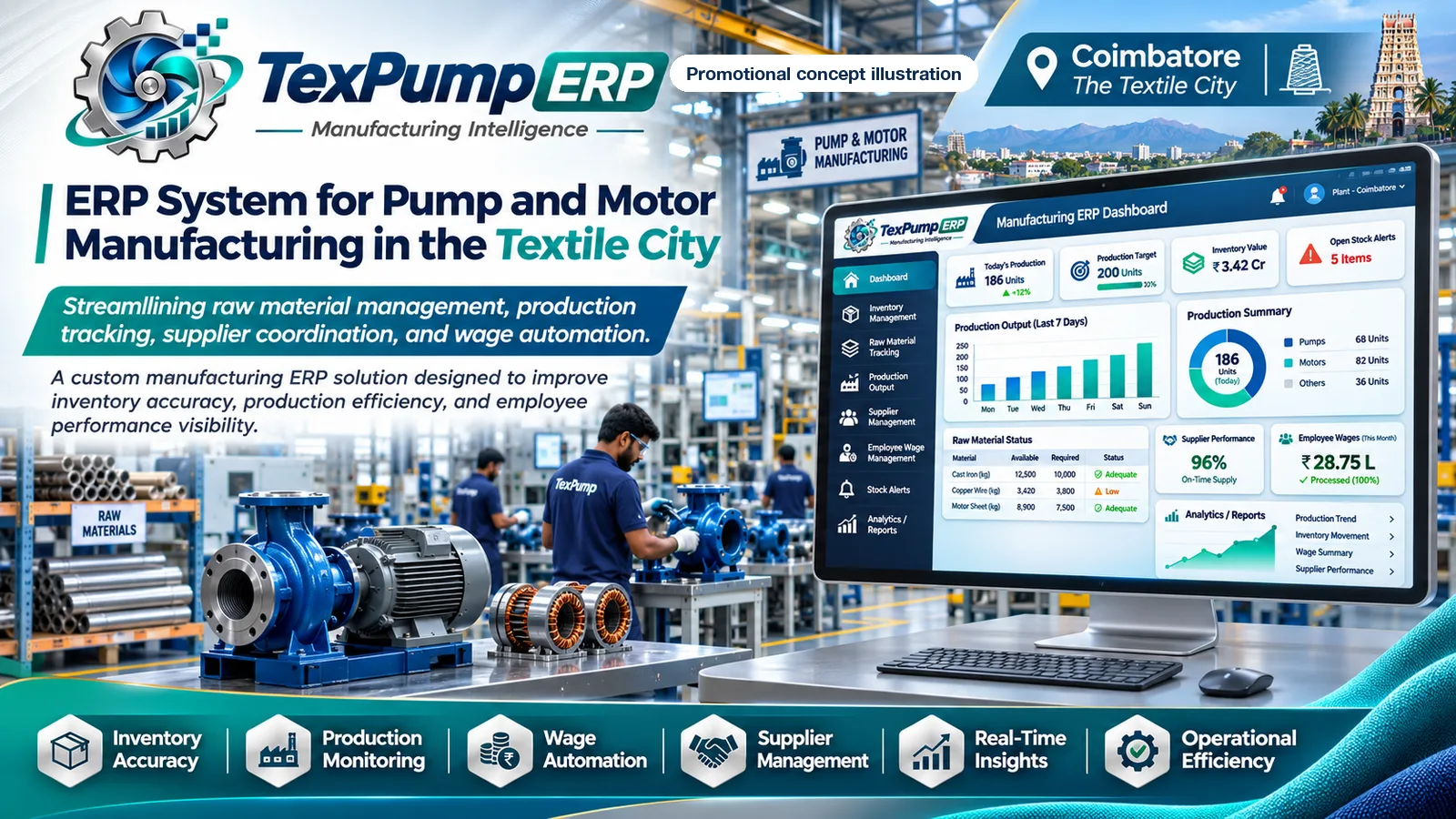
Project overview
TexPump is a pump and motor manufacturer in Coimbatore, Tamil Nadu. Its production involves several linked activities: buying or making raw materials, keeping track of inventory, assembling products, and paying employees according to what they produce. To bring these under control, TexPump partnered with RuteAppz to build a custom Enterprise Resource Planning (ERP) system tailored to its manufacturing processes, branded TexPump ERP.
| Client | TexPump |
|---|---|
| Location | Coimbatore, Tamil Nadu, India |
| Industry | Pump and motor manufacturing |
| Project | Custom manufacturing ERP system (TexPump ERP) |
| Modules | Inventory, production tracking, employee wages, supplier management, dashboards and reports |
| Project status | Delivered |
Business challenges
Manufacturing records only help if they agree with each other. TexPump faced these challenges:
- Raw-material management. Materials come from suppliers or are made in-house, and their use across different products has to be tracked so that stock stays accurate.
- Production monitoring. The output of employees had to be tracked, and raw-material usage had to be linked to finished product counts to avoid discrepancies.
- Employee wages. Wages depend on the number and type of products each employee manufactured or assembled, which made manual calculation slow.
- Disconnected data. Supplier management, inventory control, production tracking and payroll needed to live in one system.
- Manual errors. Manual data entry and the lack of timely tracking led to inaccuracies and inefficiencies.
The custom ERP solution
RuteAppz built a tailored ERP that brings the manufacturer's core operational records into a single system: inventory, production, employee wages and suppliers, with dashboards and reports on top. Because it was designed around TexPump's own workflow, including output-based wages and the matching of materials to finished products, it does not depend on a generic ERP package, and no integration with another ERP product is described or claimed.
Features
What RuteAppz built
Raw-material tracking
Visibility into materials procured or manufactured in-house, including supplier details.
Usage monitoring
Raw-material consumption is updated as products are assembled.
Stock alerts
Notifications for low inventory levels to avoid interrupting production.
Production tracking
The number and type of products assembled or manufactured.
Material reconciliation
Raw-material usage matched with finished product counts.
Wage calculation
Wages calculated from the products each employee worked on.
Productivity reports
Reports on employee productivity and efficiency based on output.
Suppliers, dashboards and reports
Central supplier records, dashboards and reports for cost analysis and production trends.
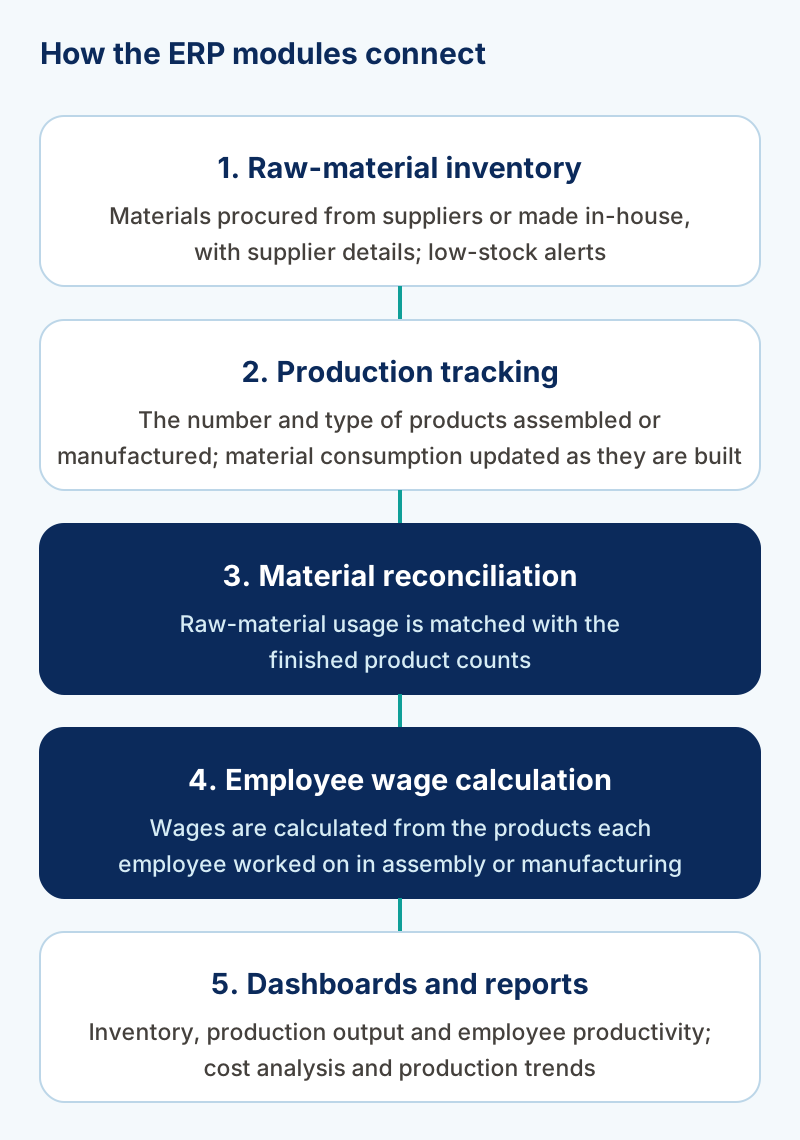
How the ERP modules connect
The workflow below follows the project document: raw materials are recorded in inventory, production is tracked, material usage is reconciled with finished products, wages are calculated from production, and dashboards and reports bring it together.
Raw-material management
The ERP records the raw materials TexPump procures from suppliers or manufactures in-house, with the supplier details attached. It shows what is available and, as products are assembled, updates the consumption of each material, so stock records follow production instead of waiting for manual entry. When inventory runs low, the system raises a stock alert so that production is not interrupted. The source does not describe barcode scanning, RFID, sensors or automatic purchasing, and none are claimed.
Production and assembly monitoring
The production module tracks the number and type of products assembled or manufactured. Each completed item is recorded against the work that produced it, giving management a running picture of output. This production record is also the link to the other modules: it is what material consumption is checked against, and what wages are calculated from. The source does not describe machine integration, predictive maintenance or production-scheduling algorithms, so none are claimed.
Material-to-production reconciliation
A central idea of the project is that materials used and products made must agree. The ERP reconciles raw-material usage with finished product counts, so that the materials consumed can be compared with the output they produced. That gives TexPump better visibility into material usage relative to production and helps avoid discrepancies between the stock records and the production records. The reconciliation compares recorded figures; the source does not claim that the software automatically detects theft, defects or waste.
Employee wage automation
TexPump pays employees by the products they manufacture or assemble. The ERP records each employee's production, by number and type of product, and calculates wages from that output using the production-based rules, replacing manual calculation. The aim, as reported for the project, is accurate and timely payment based on output. The source describes the calculation of wages from production only; it does not describe statutory payroll compliance, PF or ESI, tax withholding, attendance biometrics, bank transfers or automated salary payment, and none are claimed.
Employee productivity reports
Because production is recorded per employee, the system can report on employee productivity and efficiency in terms of manufactured output. These reports give management insight into how production is distributed across the team and support production planning. They are output reports; the source does not describe monitoring of individuals beyond the products they produce.
Supplier management
Supplier information lives in the same system as inventory. The ERP keeps centralized supplier records, including material costs, delivery timelines and payment statuses, so that purchasing information sits next to the stock it relates to. The project document describes this as improving coordination with suppliers; it does not describe purchase-order approval workflows, a supplier portal or payment integrations.
Dashboards and reporting
Custom dashboards let the management team monitor inventory, production output and employee performance in one place. Reports provide data for decisions, including cost analysis and production trends. The source describes dashboards and reports on the recorded data; it does not describe forecasting, artificial intelligence or business-intelligence tool integrations.
Technology and scope
The project delivered a custom ERP for TexPump covering inventory, production, wages, suppliers, dashboards and reports. The source material does not specify the programming language, frameworks, database, hosting, whether the system runs in the cloud or on the company's premises, the number of users or factories, or the implementation timeline, so none of these are listed.
Reported results and intended benefits
Reported project results
- Key processes were automated, reducing manual errors and inefficiencies.
- Tracking raw materials and finished products improved stock management and inventory accuracy.
- Insights into employee performance and material usage supported better production planning.
- Automated calculations made wage payments based on output more accurate and timely.
- The system improved coordination and transactions with suppliers.
What the ERP was built to provide
- Raw-material, consumption and stock-alert records.
- Production output tracking and reconciliation with materials used.
- Output-based wage calculation and productivity reports.
- Central supplier records, dashboards and cost and production reports.
These results are described qualitatively in the client project document. No measurements have been supplied for publication, so this case study makes no claims about percentages, savings, revenue, production volumes or user numbers. The cover image is promotional concept artwork: its dashboard figures are samples, not real factory data.
Related RuteAppz solutions
- RuteAppz services: custom software, web and mobile development for business operations.
- Industries: the sectors RuteAppz builds software for.
Need a Custom ERP for Your Manufacturing Business?
Build tailored manufacturing software for inventory, production tracking, material reconciliation, employee wages and operational reporting.
More case studies

Vaikol
How RuteAppz Built a Custom Animal Feed Ordering and Delivery App for Vaikol
A custom mobile app system for an animal feed supplier: a customer app for pre-orders, a driver app with proof of delivery, and an admin dashboard.
Read story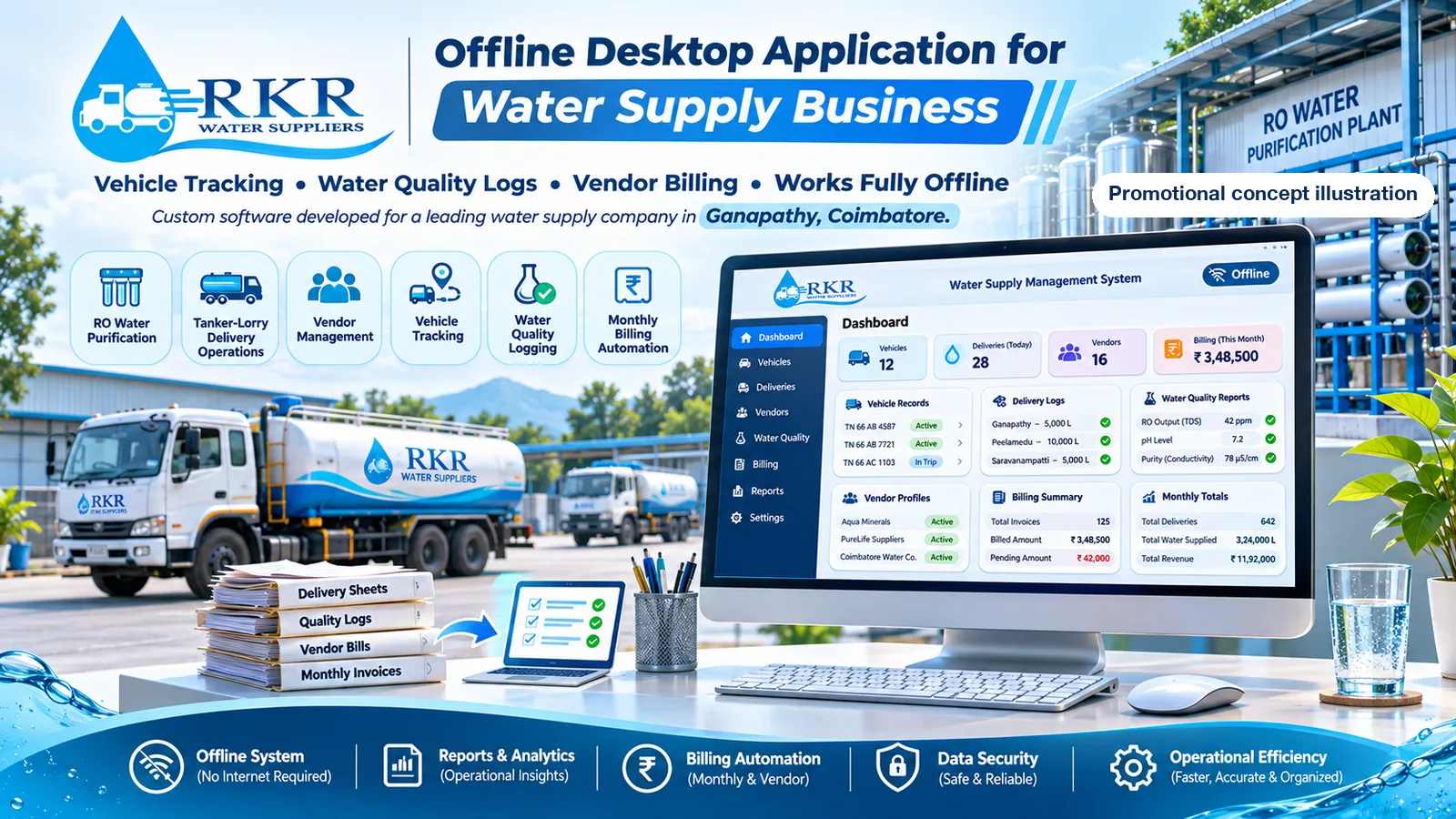
RKR Water Suppliers
How RuteAppz Built an Offline Water Supply Management & Billing Application
A custom offline desktop application for recording tanker deliveries, managing vendors, documenting water quality and preparing monthly bills without internet dependency.
Read story
Stitchwell Digitizing
How RuteAppz Developed a Custom Order Management Platform for Stitchwell Digitizing
A custom web platform for embroidery digitizing and vector artwork orders, quotations, revisions, file delivery and invoicing.
Read story